Programme highlights
Get qualified to work as an engineering technologist – an area critical to the economy in New Zealand and overseas.
In this three-year programme, you’ll learn core skills in engineering theory.
Find out what it takes to create new roads, build bridges and plan other infrastructure projects.
You can also choose to specialise in:
- Structural
- Water and water waste.
When you graduate, you’ll be ready for a job as a professional engineering technologist.
Entry requirements
Applicants must meet the following entry requirements:
Academic
University Entrance – NCEA Level 3 including:
- Three subjects at Level 3 including:
- Physics with a minimum of 14 credits;
- Calculus with a minimum of 14 credits; and
- One other subject from the list of approved subjects*.
- Literacy – 10 credits at Level 2 or above, made up of five credits in reading, five credits in writing;
- Numeracy – 10 credits at Level 1 or above (specified achievement standards, or unit standards 26623, 26626, 26627);
Or
- Equivalent academic qualifications (Equivalent academic qualifications may include University B Bursary with 45% or more in both Physics and Calculus or Algebra);
Or
- Equivalent Cambridge score;
Or
- Equivalent International Baccalaureate.
*NZQA approved subjects: see http://www.nzqa.govt.nz/qualifications-standards/awards/university-entrance
English language entry requirements
Applicants must have sufficient competence in the English language to undertake this programme, which is taught and assessed in English.
Any applicant whose first language is not English may be required to provide evidence of their English language competency.
International students: English language entry requirements
EAL students must meet the minimum academic entry requirements and have achieved an overall band score (Academic) of 6.0 IELTS, (writing and speaking score no less than 6.0 and reading and listening bands no less than 5.5) or equivalent.
Other entry requirements
Applicants must be physically capable of completing the practical aspects of the programme, by being able to work effectively, efficiently and safely.
Give yourself credit with Recognition of Prior Learning (RPL)
Did you know you can use the knowledge and experience you already have to your advantage?
Your previous work experience and on-the-job skills, volunteering, professional development, and other providers’ qualifications can be recognised as prior learning, matched against credits in our courses, and put towards your qualification – potentially saving you money and possibly helping you to complete your qualification faster Learn more.
Programme structure
You will need to complete the below courses related to your chosen specialisation (360 credits):
Structural
Level 5
114.508 Engineering Design & Drawing (15 credits)
Metro Group course code: MG5005
The aim is to enable students to gain an understanding of engineering design, drawing practice and modelling in an applied context.
The learning outcomes on successful completion of this course are the student should be able to:
- Describe the stages of the design process.
- Apply the principles, standards, and techniques of design and drawing used in engineering contexts.
- Use models and drawings to meet given briefs and communicate outcomes of solutions.
124.504 Mechanics (15 credits)
Metro Group course code: MG5002
The aim is to enable students to gain an understanding of the fundamental principles and laws of mechanics.
On successful completion of this course the student will be able to:
- Analyse basic theory, principles and application of forces and moments in mechanics and engineering
- Calculate indirect stresses (bending and torsion) in mechanical components and select appropriate sections from standard tables
- Analyse the forces, moments, torques, work and energy, including conservation of energy, resulting from linear acceleration, rotational acceleration and centripetal acceleration
- Analyse the basic principles of fluids analysis.
141.517 Engineering Mathematics Level 5 (15 credits)
Metro Group course code: MG5004
The aim is to enable students to gain an understanding of general mathematical principles and equip them with appropriate engineering mathematical skills to solve engineering problems.
The learning outcomes on successful completion of this course are the student should be able to:
- Analyse graphs.
- Manipulate and solve algebraic expressions and equations.
- Manipulate and apply complex numbers.
- Use matrices to solve problems.
- Apply differentiation and integration of mathematical techniques to solve engineering problems.
- Derive and solve differential equations.
181.518 Engineering Communication (15 credits)
Metro Group course code: MG5003
The aim is to enable students to communicate effectively in their professional environment.
The learning outcomes on successful completion of this course are the student should be able to:
- Write effective reports.
- Design relevant documentation.
- Make effective presentations.
- Give and receive clear instructions.
- Research and reference to support the field of study.
242.511 Civil Materials (15 credits)
Metro Group course code: MG5107
The aim is to introduce the properties and application of a range of civil engineering materials and the fundamentals of geological and geomorphological processes.
The learning outcomes on successful completion of this course are the student should be able to:
- Describe and evaluate the properties and applications of concrete in Civil Engineering.
- Describe and evaluate the properties and applications of metals, timber and new materials in Civil Engineering.
- Identify and describe the composition of minerals and rocks and discuss soil and rock formation processes.
- Describe and evaluate earthquakes, physical and structural geology, and interpret geological maps.
242.521 Geotechnical Engineering 1 (15 credits)
Metro Group course code: MG5009
The aim is to introduce the fundamentals of soil composition, the engineering properties of soils, and site investigation procedures.
On successful completion of this course, the student should be able to:
- Describe soil composition and calculate soil phase ratios.
- Determine basic engineering properties of soils.
- Classify soils in the field and from laboratory results.
- Describe and evaluate methods to improve the engineering properties of soils.
- Plan geotechnical site investigations and interpret the results.
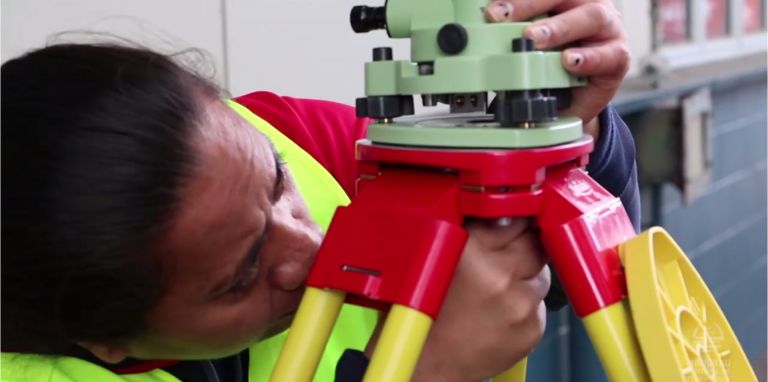
242.522 Land Surveying 1 (15 credits)
Metro Group course code: MG5006
The aim is to understand and apply the theoretical and practical concepts of land surveying.
On successful completion of this course the student will be able to:
- Understand principles of land surveying and use survey instruments.
- Understand and apply fundamental principles and techniques of levelling, traversing and co-ordinate calculations, and error distribution.
- Use equipment and techniques for field and distance measurements.
242.523 Structures 1 (15 credits)
Metro Group course code: MG5032
Pre-requisite: 124.504 Mechanics
The aim is to analyse structural elements and simple structures.
On successful completion of this course, the student should be able to:
- Calculate stresses caused by axial forces, shear forces and bending moments.
- Analyse simple structural elements and structures.
- Evaluate the range of common structural loadings and their effect on structures.
242.515 Fluid Mechanics (Civil) (15 credits)
Metro Group course code: MG5008
Pre-requisite: 124.504 Mechanics
The aim is to introduce the principles of fluid mechanics and apply them in civil engineering hydraulic applications.
The learning outcomes on successful completion of this course are the student should be able to:
- Apply the principles of fluid statics and dynamics.
- Analyse pipelines and pipe networks.
- Analyse uniform and non-uniform open channel flow.
- Determine the operating characteristics of pumps in a range of pipeline systems.
- Evaluate the operation and application of a range of equipment used for the measurement of fluid flow in open and closed conduits.
242.524 Highway Engineering 1 (15 credits)
Metro Group course code: MG5012
The aim is to introduce the fundamentals of road materials, road construction practices, principles of drainage design, and basic geometrical and pavement design of subdivision roading.
The learning outcomes on successful completion of this course are the student should be able to:
- Outline and describe road infrastructure administration agencies.
- Evaluate the properties and testing of road earthworks, pavement and wearing surface materials, discuss road construction practice and pavement distress.
- Evaluate the components, functions and design of surface and sub-surface drainage for roads.
- Simple geometric and structural/pavement design for subdivision roading to local standards.
502.514 Engineering Computing (15 credits)
Metro Group course code: MG5001
The aim is to enable students to develop an understanding of computing principles and their use in engineering practice.
The learning outcomes on successful completion of this course are the student should be able to:
- Solve engineering problems using an engineering maths and analysis package.
- Develop a program to a specification by devising, coding and testing an algorithm to solve a specified problem.
- Use software packages, including spreadsheets, database and discipline-specific software to produce engineering solutions.
Level 6
115.619 Engineering Management (15 credits)
Metro Group course code: MG6103
Pre-requisite: 181.518 Engineering Communication MG5003
The aim is to develop the knowledge and skills required to administer and manage projects effectively in a specific strand of engineering.
On successful completion of this course, the student should be able to:
- Identify the parties involved in an engineering project and evaluate the roles and responsibilities that each has.
- Apply the fundamentals of project management to a well-defined engineering project.
- Appraise the procurement process, evaluate contract documentation and prepare cost estimates for a well-defined engineering project.
- Demonstrate how to administer and supervise projects, contracts and engineering works in accordance with the relevant standards and/or codes of practice.
- Critically evaluate professional practice principles and their application to an engineering environment.
242.608 Civil Engineering Detailing and Modelling (15 credits)
Metro Group course code: MG6005
Pre-requisite: 114.508 Engineering Design & Drawing
The aim is to enable students to further develop the principles and practice of civil engineering drawing, detailing and modelling.
The learning outcomes on successful completion of this course are the student should be able to:
- Produce structural drawings in structural concrete, steel and timber, roading and drainage to nationally recognised drafting standards.
- Use and evaluate computer-based information systems, modelling and visualisation in the design and management of civil engineering projects.
- Use a software package to explore aspects of a civil engineering project.
242.609 Civil Engineering Construction Practices (15 credits)
Metro Group course code: MG6106
Pre-requisite: 181.518 Engineering Communication
The aim is to enable students to develop an understanding of the practical aspects of sound civil engineering practice.
The learning outcomes on successful completion of this course are the student should be able to:
- Appraise the plant and methods used in the full range of civil engineering construction activities.
- Develop and implement safety plans for the full range of civil engineering construction activities.
- Develop and implement quality control plans for the full range of civil engineering construction activities.
- Develop and implement environmental protection plans for the full range of civil engineering construction activities.
242.626 Structures 2 (15 credits)
Metro Group course code: MG6046
Pre-requisite: 242.523 Structures 1
The aim is to enable students to apply principles and practices involved in the design of simple structures.
On the successful completion of this course the student will be able to:
- Analyse the effects of actions on structures.
- Analyse load-carrying systems, determinate structural systems, and indeterminate structural systems.
- Use structural analysis and design software to investigate given structures.
242.611 Structural Steel and Timber (15 credits)
Metro Group course code: MG6007
Pre-requisite: 242.626 Structures 2
The aim is to enable students to develop the principles and practice of structural design for steel and timber structures.
The learning outcomes on successful completion of this course are the student should be able to:
- Apply design methods for accommodating wind action on structures to practical situations.
- Appraise the properties and behaviour of structural steel and structural timber.
- Apply design data to the practical design of structural steelwork and steelwork. connections.
- Apply design data to the practical design of structural timber.
242.612 Structural Concrete (15 credits)
Metro Group course code: MG6008
Pre-requisite: 242.626 Structures 2
The aim is to enable students to develop the principles and practice of structural design for reinforced and prestressed concrete structures.
The learning outcomes on successful completion of this course are the student should be able to:
- Apply design methods for accommodating earthquake action on structures to practical situations.
- Appraise the properties and behaviour of concrete in structures.
- Apply design data to the practical design of reinforced concrete elements.
- Apply design data to the practical design of pre-stressed concrete beams.
- Appraise structural design aspects of concrete masonry in simple structures.
242.630 Engineering Geotechnical 2 (15 credits)
Metro Group course code: MG6012
Pre-requisite: 242.511 Civil Materials, 242.521 Geotechnical Engineering
The aim is to develop further knowledge of the principles and practice of geotechnical engineering.
The learning outcomes on successful completion of this course are the student should be able to:
- Examine the occurrence and flow of water through soils and discuss the impact soil water has in engineering practice.
- Determine and evaluate the shear strength parameters of soils.
- Determine the earth pressure on, and analyse the stability of, earth retaining structures.
- Analyse the stability of earth slopes.
- Determine the bearing capacity of shallow and deep foundations.
- Understand the process of consolidation and estimate consolidation settlement.
- Describe the causes of liquefaction and how these can be controlled to reduce the effects of liquefaction.
Level 7
115.719 Engineering Development Project (30 credits)
Metro Group course code: MG7101
Pre-requisite: at least 45 Level 6 credits
*This is a year-long course
The aim is to enable students to investigate an engineering problem; to propose, specify, design and develop a solution and where feasible, to construct and test a prototype.
The learning outcomes on successful completion of this course are the student should be able to:
- Synthesise a solution for an engineering problem.
- Complete a project to a specified standard.
- Design, project manage and evaluate a concept/model/product.
- Use software application packages as an engineering tool, if required.
- Communicate effectively with customers, peers, technicians and engineers.
115.720 Professional Engineering Practice (15 credits)
Metro Group course code: MG7121
Pre-requisite: 181.518 Engineering Communication
The aim is to enable students to critically apply knowledge and understanding of professional practice for engineers, professional engineering roles and activities and their interactions with society and the environment.
The learning outcomes on successful completion of this course are the student should be able to:
- Appraise the professional role of engineers in society and industry.
- Evaluate and apply laws within the engineering practice area.
- Critique moral and ethical issues related to the environment in an engineering context.
- Critically explore issues relating to behavioural management in the practice of engineering.
- Critically apply knowledge of Māori cultural concepts and perspectives to those of the Crown and project management development.
242.700 Design of Structures (15 credits)
Metro Group course code: MG7004
Pre-requisite: 242.611 Structural Steel and Timber, 242.612 Structural Concrete
The aim is to enable students to use projects and case studies for the application of structural principles and design to broadly defined structural engineering problems.
The learning outcomes on successful completion of this course are the student should be able to:
- Appraise and apply the use of computer programs within the context of structural projects.
- Synthesise design solutions for structural elements and structures.
- Present and validate the efficacy of design solutions.
341.755 Project Management (15 credits)
Metro Group course code: MG7025
Pre-requisite:115.619 Engineering Management
The aim is to enable students to apply project management principles, concepts and techniques.
The learning outcomes on successful completion of this course are the student should be able to:
- Initiate, plan, execute, monitor, control, and closeout an engineering project.
341.756 Risk Management (15 credits)
Metro Group course code: MG7026
Pre-requisite: 115.619 Engineering Management
The aim is to enable students to learn and apply the principles and processes of Risk Management in the context of engineering and business management.
The learning outcomes on successful completion of this course are the student should be able to:
- Define objectives of risk management and determine criteria for measurement and analysis of problems.
- Utilise analytical evaluation and decision making methodologies to determine project direction and choices.
- Critically analyse risk management approaches and methodologies.
Water and water waste
Level 5
114.508 Engineering Design & Drawing (15 credits)
Metro Group course code: MG5005
The aim is to enable students to gain an understanding of engineering design, drawing practice and modelling in an applied context.
The learning outcomes on successful completion of this course are the student should be able to:
- Describe the stages of the design process.
- Apply the principles, standards, and techniques of design and drawing used in engineering contexts.
- Use models and drawings to meet given briefs and communicate outcomes of solutions.
124.504 Mechanics (15 credits)
Metro Group course code: MG5002
The aim is to enable students to gain an understanding of the fundamental principles and laws of mechanics.
On successful completion of this course the student will be able to:
- Analyse basic theory, principles and application of forces and moments in mechanics and engineering
- Calculate indirect stresses (bending and torsion) in mechanical components and select appropriate sections from standard tables
- Analyse the forces, moments, torques, work and energy, including conservation of energy, resulting from linear acceleration, rotational acceleration and centripetal acceleration
- Analyse the basic principles of fluids analysis.
141.517 Engineering Mathematics Level 5 (15 credits)
Metro Group course code: MG5004
The aim is to enable students to gain an understanding of general mathematical principles and equip them with appropriate engineering mathematical skills to solve engineering problems.
The learning outcomes on successful completion of this course are the student should be able to:
- Analyse graphs.
- Manipulate and solve algebraic expressions and equations.
- Manipulate and apply complex numbers.
- Use matrices to solve problems.
- Apply differentiation and integration mathematical techniques to solve engineering problems.
- Derive and solve differential equations.
181.518 Engineering Communication (15 credits)
Metro Group course code: MG5003
The aim is to enable students to communicate effectively in their professional environment.
The learning outcomes on successful completion of this course are the student should be able to:
- Write effective reports.
- Design relevant documentation.
- Make effective presentations.
- Give and receive clear instructions.
- Research and reference to support the field of study.
242.511 Civil Materials (15 credits)
Metro Group course code: MG5107
The aim is to introduce the properties and application of a range of civil engineering materials and the fundamentals of geological and geomorphological processes.
The learning outcomes on successful completion of this course are the student should be able to:
- Describe and evaluate the properties and applications of concrete in Civil Engineering.
- Describe and evaluate the properties and applications of metals, timber and new materials in Civil Engineering.
- Identify and describe the composition of minerals and rocks and discuss soil and rock formation processes.
- Describe and evaluate earthquakes, physical and structural geology, and interpret geological maps.
242.522 Land Surveying 1 (15 credits)
Metro Group course code: MG5006
The aim is to understand and apply the theoretical and practical concepts of land surveying.
The learning outcomes on successful completion of this course are the student should be able to:
- Understand principles of land surveying and use survey instruments.
- Understand and apply fundamental principles and techniques of levelling, traversing and co-ordinate calculations, and error distribution.
- Use equipment and techniques for field and distance measurements.
242.523 Structures 1 (15 credits)
Metro Group course code: MG5032
Pre-requisite: 124.504 Mechanics
The aim is to analyse structural elements and simple structures.
On successful completion of this course, the student should be able to:
- Calculate stresses caused by axial forces, shear forces and bending moments.
- Analyse simple structural elements and structures.
- Evaluate the range of common structural loadings and their effect on structures.
242.515 Fluid Mechanics (Civil) (15 credits)
Metro Group course code: MG5008
Pre-requisite: 124.504 Mechanics
The aim is to introduce the principles of fluid mechanics and apply them in civil engineering hydraulic applications.
The learning outcomes on successful completion of this course are the student should be able to:
- Apply the principles of fluid statics and dynamics.
- Analyse pipelines and pipe networks.
- Analyse uniform and non-uniform open channel flow.
- Determine the operating characteristics of pumps in a range of pipeline systems.
- Evaluate the operation and application of a range of equipment used for the measurement of fluid flow in open and closed conduits.
242.524 Highway Engineering 1 (15 credits)
Metro Group course code: MG5012
The aim is to introduce the fundamentals of road materials, road construction practices, principles of drainage design, and basic geometrical and pavement design of subdivision roading.
The learning outcomes on successful completion of this course are the student should be able to:
- Outline and describe road infrastructure administration agencies.
- Evaluate the properties and testing of road earthworks, pavement and wearing surface materials, discuss road construction practice and pavement distress.
- Evaluate the components, functions and design of surface and sub-surface drainage for roads.
- Simple geometric and structural/pavement design for subdivision roading to local standards.
502.514 Engineering Computing (15 credits)
Metro Group course code: MG5001
The aim is to enable students to develop an understanding of computing principles and their use in engineering practice.
The learning outcomes on successful completion of this course are the student should be able to:
- Solve engineering problems using an engineering maths and analysis package.
- Develop a programme to a specification by devising, coding and testing an algorithm to solve a specified problem.
- Use software packages, including spreadsheets, database and discipline-specific software to produce engineering solutions.
502.521 Geotechnical Engineering 1 (15 credits)
Metro Group course code: MG5009
The aim is to introduce the fundamentals of soil composition, the engineering properties of soils, and
site investigation procedures.
The learning outcomes on successful completion of this course are the student should be able to:
- Describe soil composition and calculate soil phase ratios.
- Determine basic engineering properties of soils.
- Classify soils in the field and from laboratory results.
- Describe and evaluate methods to improve the engineering properties of soils.
- Plan geotechnical site investigations and interpret the results.
Level 6
115.619 Engineering Management (15 credits)
Metro Group course code: MG6103
Pre-requisite: 181.518 Engineering Communication MG5003
The aim is to develop the knowledge and skills required to administer and manage projects effectively in a specific strand of engineering.
On successful completion of this course, the student should be able to:
- Identify the parties involved in an engineering project and evaluate the roles and responsibilities that each has.
- Apply the fundamentals of project management to a well-defined engineering project.
- Appraise the procurement process, evaluate contract documentation and prepare cost estimates for a well-defined engineering project.
- Demonstrate how to administer and supervise projects, contracts and engineering works in accordance with the relevant standards and/or codes of practice.
- Critically evaluate professional practice principles and their application to an engineering environment.
242.608 Civil Engineering Detailing and Modelling (15 credits)
Metro Group course code: MG6005
Pre-requisite: 114.508 Engineering Design & Drawing
The aim is to enable students to further develop the principles and practice of civil engineering drawing, detailing and modelling.
The learning outcomes on successful completion of this course are the student should be able to:
- Produce structural drawings in structural concrete, steel and timber, roading and drainage to nationally recognised drafting standards.
- Use and evaluate computer-based information systems, modelling and visualisation in the design and management of civil engineering projects.
- Use a software package to explore aspects of a civil engineering project.
242.609 Civil Engineering Construction Practices (15 credits)
Metro Group course code: MG6106
Pre-requisite: 181.518 Engineering Communication
The aim is to enable students to develop an understanding of the practical aspects of sound civil engineering practice.
The learning outcomes on successful completion of this course are the student should be able to:
- Appraise the plant and methods used in the full range of civil engineering construction activities.
- Develop and implement safety plans for the full range of civil engineering construction activities.
- Develop and implement quality control plans for the full range of civil engineering construction activities.
- Develop and implement environmental protection plans for the full range of civil engineering construction activities.
242.627 Water and Waste Systems (15 credits)
Metro Group course code: MG6109
Co-requisite: 242.515 Fluid Mechanics (Civil) MG5008
The aim is to evaluate the requirements of, and design water, waste water and storm water reticulation systems.
On successful completion of this course, the student should be able to:
- Analyse water supply and demand requirements, and design a small water reticulation system.
- Evaluate hydrological parameters and design an urban storm water management system.
- Determine waste water quantities and design a waste water reticulation system.
- Appraise the requirements of water and wastewater pumping installations and optimise design.
- Evaluate integrated water management approaches.
242.628 Water and Waste Management (15 credits)
Metro Group course code: MG6110
The aim is to develop knowledge and understanding of drinking water quality control parameters and treatment methods, and of current and emerging treatment technologies for liquid and solid wastes.
On successful completion of this course, the student should be able to:
- Evaluate and apply drinking water standards and quality parameters.
- Understand and appraise the principles and practice of water treatment.
- Evaluate and apply waste water quality parameters.
- Evaluate wastewater and solid waste treatment and disposal methods.
- Critically evaluate environmental impact and Māori cultural values in relation to water supply and waste management.
242.615 Hydrology and Erosion Management (15 credits)
Metro Group course code: MG6011
The aim is to enable students to learn about catchment runoff, erosion, water balances and sustainable land use.
The learning outcomes on successful completion of this course are the student should be able to:
- Appraise the factors and inter-relationships which affect catchment processes and sustainable management.
- Appraise causes of stream erosion and the range of procedures available for flood routing and reduction of peak flows and velocities.
- Appraise sustainable land use and appropriate remedial measures for both rural and town construction sites.
- Evaluate techniques for mitigating coastal erosion.
242.630 Engineering Geotechnical 2 (15 credits)
Metro Group course code: MG6012
Pre-requisite: 242.511 Civil Materials, 242.521 Geotechnical Engineering 1
The aim is to develop further knowledge of the principles and practice of geotechnical engineering.
The learning outcomes on successful completion of this course are the student should be able to:
- Examine the occurrence and flow of water through soils and discuss the impact soil water has in engineering practice.
- Determine and evaluate the shear strength parameters of soils.
- Determine the earth pressure on, and analyse the stability of, earth retaining structures.
- Analyse the stability of earth slopes.
- Determine the bearing capacity of shallow and deep foundations.
- Understand the process of consolidation and estimate consolidation settlement.
- Describe the causes of liquefaction and how these can be controlled to reduce the effects of liquefaction.
Level 7
115.719 Engineering Development Project (30 credits)
Metro Group course code: MG7101
Pre-requisite: at least 45 Level 6 credits
*This is a year-long course
The aim is to enable students to investigate an engineering problem; to propose, specify, design and develop a solution and where feasible, to construct and test a prototype.
The learning outcomes on successful completion of this course are the student should be able to:
- Synthesise a solution for an engineering problem.
- Complete a project to a specified standard.
- Design, project manage and evaluate a concept/model/product.
- Use software application packages as an engineering tool, if required.
- Communicate effectively with customers, peers, technicians and engineers.
115.720 Professional Engineering Practice (15 credits)
Metro Group course code: MG7121
Pre-requisite: 181.518 Engineering Communication
The aim is to enable students to critically apply knowledge and understanding of professional practice for engineers, professional engineering roles and activities and their interactions with society and the environment.
The learning outcomes on successful completion of this course are the student should be able to:
- Appraise the professional role of engineers in society and industry.
- Evaluate and apply laws within the engineering practice area.
- Critique moral and ethical issues related to the environment in an engineering context.
- Critically explore issues relating to behavioural management in the practice of engineering.
- Critically apply knowledge of Māori cultural concepts and perspectives to those of the Crown and project management development.
242.701 Urban Drainage Systems (15 credits)
Metro Group course code: MG7005
Pre-requisite: 242.627 Water and Waste Systems
The aim is to enable students to develop an understanding of urban wastewater and stormwater systems.
The learning outcomes on successful completion of this course are the student should be able to:
- Evaluate the key aspects in planning and design of wastewater reticulation systems.
- Appreciate the role of mathematical models and simulations of wastewater reticulation systems.
- Evaluate the key aspects in planning and design of stormwater drainage systems.
341.755 Project Management (15 credits)
Metro Group course code: MG7025
Pre-requisite: 115.619 Engineering Management
The aim is to enable students to apply project management principles, concepts and techniques.
The learning outcomes on successful completion of this course are the student should be able to:
- Initiate, plan, execute, monitor, control, and closeout an engineering project.
341.756 Risk Management (15 credits)
Metro Group course code: MG7026
Pre-requisite: 115.619 Engineering Management
The aim is to enable students to learn and apply the principles and processes of Risk Management in the context of engineering and business management.
The learning outcomes on successful completion of this course are the student should be able to:
- Define objectives of risk management and determine criteria for measurement and analysis of problems.
- Utilise analytical evaluation and decision-making methodologies to determine project direction and choices.
- Critically analyse risk management approaches and methodologies.
Accreditation by Engineering New Zealand (EngNZ) confirms that the Bachelor of Engineering Technology meets national and international benchmarked standards for first degrees for professional engineers in South Africa, USA, Canada, the United Kingdom, Ireland, Hong Kong, Australia, and New Zealand. EngNZ accreditation also provides recognition for professional membership and registration/licensing purposes in those countries.
Do you want to study a single course, without enrolling into the full programme?
Courses within some of our programmes may be offered as an individual Certificate of Proficiency (COP). Programme entry requirements and course fees apply. For more information, please speak to our friendly Ask Me! team.
Further training or study
Upon completion of this programme, students can continue towards:
Career opportunities
This degree has been developed by a national consortium of tertiary providers, in conjunction with industry, to prepare graduates for a career in the diverse field of civil engineering. Graduates will be in a position to enter into employment as well as develop their capacity to attain professional competence and to fulfill the role of a professional engineering technologist.