

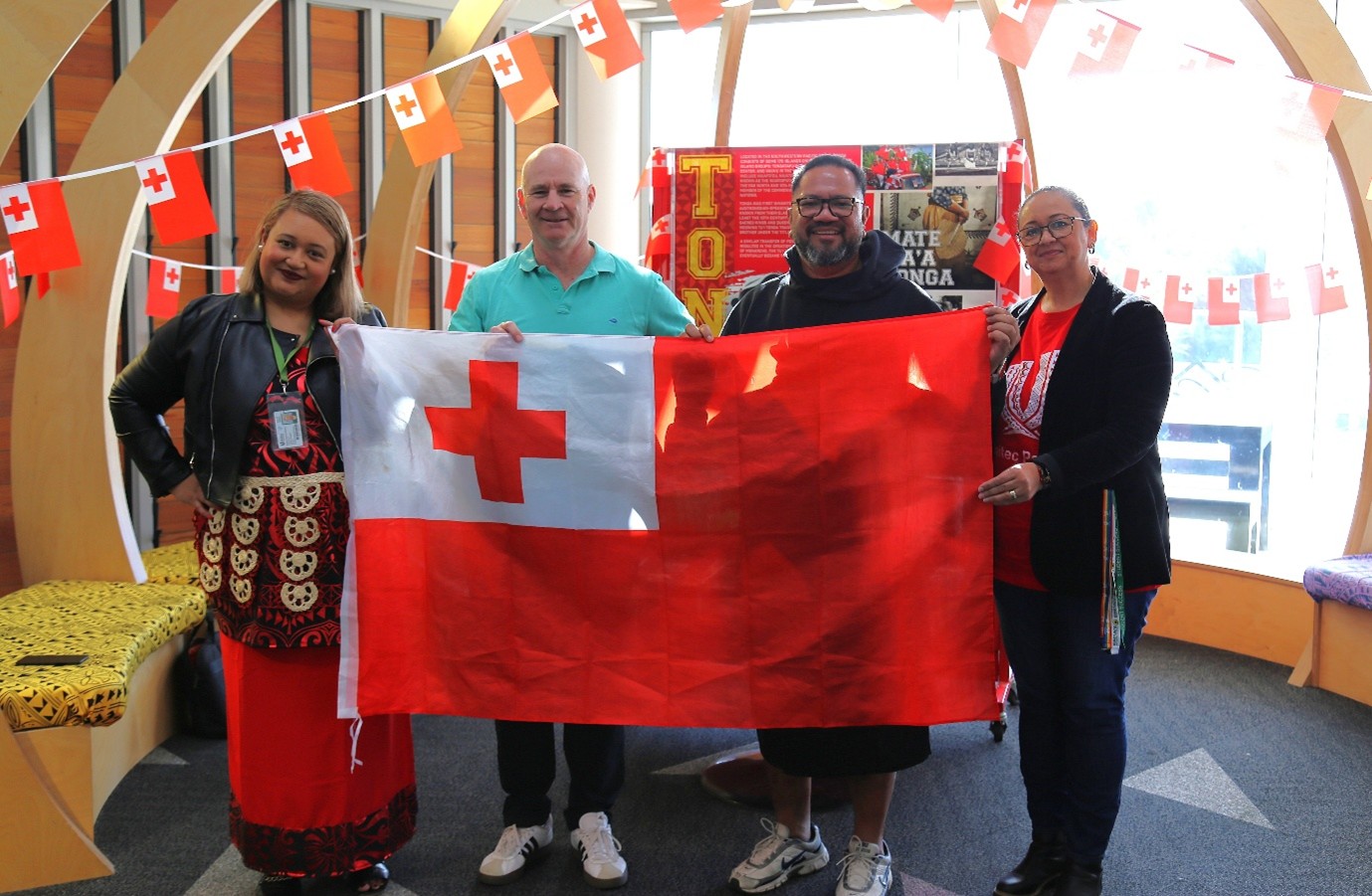
Tongan kaimahi Helena Finau-Hakalo, Jason Hallie, Ioane Aleke Faavae and Annette Pitovao proudly fly the Tongan flag at our Tongan Language Week display at our Ōwairaka I Mt Albert Campus
In Brief:
- Staff and ākonga ‘learners’ share how they keep lea faka-Tonga, cultural values and identity alive in their workplaces, studies, families and communities.
- Tongan Language Week from 16–22 August, provides an opportunity to strengthen connections with Tongan ākonga, staff, families and communities, with events across the Ōtara, Manukau, Waitākere and Mt Albert campuses.
Tongan Language Week (Uike Kātoanga’i ‘o e Lea Faka-Tonga) is bringing together kaimahi ‘staff’ and ākonga ‘learners’ to celebrate language, culture and identity across our campuses.
There are 38 kaimahi working across our organisation of Tongan heritage, 13 at our Otara, Tech Park and Manukau Campuses and 25 kaimahi at our Mt Albert and Waitākere Campuses.
For Senior Lecturers Anna Cullen, Sione Kavaliku, Dr Semisi James Prescott, Master of Creative Practice student Sesilia Pusiaki and Tongan Student Association President Christina Vailahi, this week is about keeping their culture, identity, values and connections alive within their families, and for generations to come.
As Tongan Language Week is celebrated across Aotearoa New Zealand from 16-22 August, they share what their language and culture means to them, and how they carry their Tongan identity – not just in their homes, but also at work and in the classroom.
Anna, who supports our Pacific Language Courses in Ōtara, says speaking lea faka-Tonga is a way of maintaining a deep connection to her family, heritage and the values that shape Tongan identity.
Sione, an automotive tutor at our Ōwairaka I Mt Albert Campus, sees language as a way of passing culture, values and identity to his children and future generations.
Dr Prescott, an accounting lecturer in Mt Albert, believes that the preservation of language and culture go hand-in-hand.
Sesilia says speaking lea faka-Tonga enables her to express who she is and bring Tongan knowledge, genealogy, oral histories and lived experience into her research as a postgraduate student.
Christina Vailahi wants other Tongan students to feel proud of who they are and confident in carrying their culture forward.
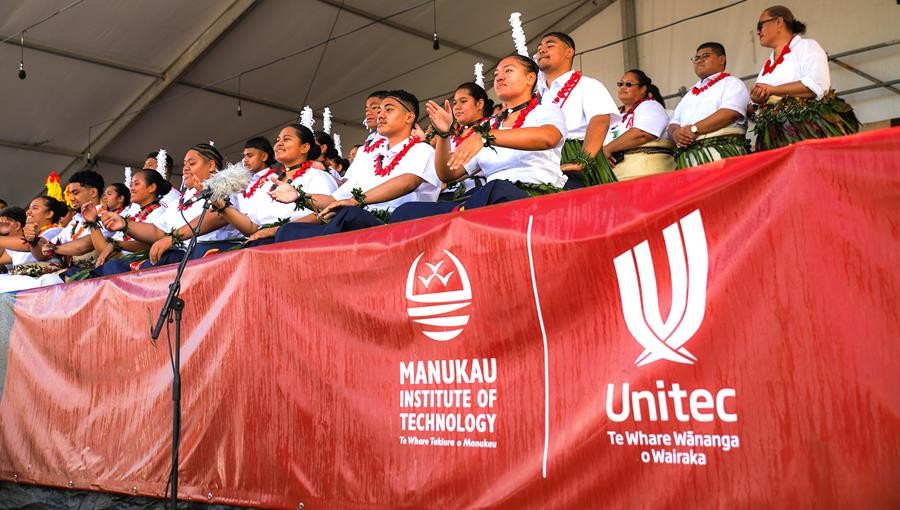
MIT & Unitec sponsored the Tongan stage at 2025 ASB Polyfest
The theme of this year’s Tongan Language Week is ‘Ko ‘etau hiva, ko e fe’unu mahu’inga ia ki he mo’ui ‘a e Tonga – Our music is a vital strand of our Tongan culture’, which celebrates the important role music plays in maintaining and expressing Tongan identity.
Team Leader Mentoring and Scholarships Helena Finau-Hakalo says Tongan staff at Mt Albert and Waitākere are sharing daily Tongan songs this week to acknowledge the importance of this theme to maintaining Tongan identity.
Tongan Language Week is organised as part of the Ministry for Pacific Peoples’ annual Pacific Language Weeks and celebrates the language, heritage and culture of the nearly 98,000 Tongans living in Aotearoa.
It is also an opportunity for our organisation to acknowledge and strengthen our connections with our Tongan ākonga and staff, as well as their families and communities.
Those connections extend beyond the classroom through several on campus and community initiatives.
The Tongan Students Association has been active for over a decade and hosts cultural events during the year at our Ōtara and Manukau Campuses.
The Manaaki programme provides scholarship opportunities for Tongans to study at our Mt Albert and Waitākere Campuses.
We deliver Tongan Language courses to the community at our Ōtara Campus through the Level 3 New Zealand Certificate in Pacific Language courses.
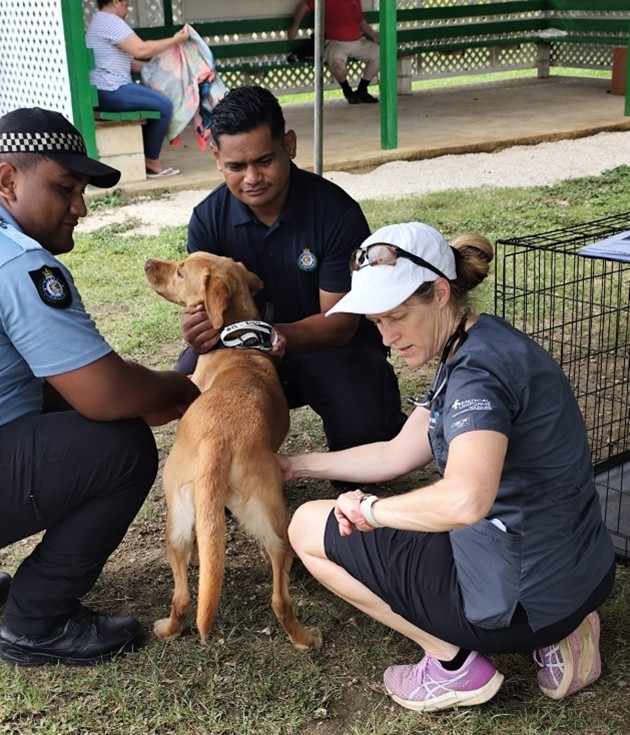
Every year, a team of our veterinary nursing students travels to Tonga to treat animals in the village of Tokomololo as part of an ongoing partnership with South Pacific Animal Welfare (pictured right).
We are also regular participants in community events such as ASB Polyfest, where MIT and Unitec sponsored the Tonga stage in 2025.
We’ve also had educational pathway agreements with Tongan institutions such as the ‘Ahopanilolo Technical Institute in Tonga in 2014 and the Tonga Institute of Science and Technology (TIST) in 2018.
What’s happening for Tongan Language Week?
Wednesday, 19 August 2026
- Fofola ‘ae fala ke alea ‘ae kainga
Rangimarie Space, B510 – Waitākere Campus | 12–1pm
Explore Tongan social work models, take part in a quick tutorial on hiva anitema/tu’unga fasi and enjoy a taste of a Tongan winter favourite, topai.
Thursday, 20 August 2026
- Te Ara Oranga: Katoanga’i ‘oe Uike ‘oe lea Fakatonga – Happy Tongan Language Week
Level 1 Pre-Function Area – Manukau Campus | 12–1pm
As this year’s theme states, music is a vital strand of our culture. So, join us in listening to the heilaki present in the music of our isles, and the highest forms of Tongan art in action! Guest speaker will be Pasifika Relations Advisor Loloa Alatini.
- Tongan Bingo
Level 1 Atrium, Te Puna, B180 – Mt Albert Campus | 12–1.30pm
Enjoy a few rounds of Tongan Bingo alongside Tongan snacks and music.
Staff, students and the wider community are invited to join these events. All welcome.
MEET OUR TONGAN COMMUNITY
“Our language is unique, precious and alive”
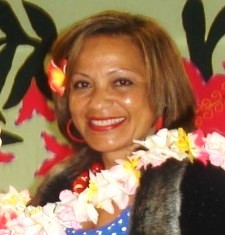 Anna Cullen Senior Lecturer, Community Enterprise Unit
I am proud to be Tongan because of our strong culture, traditions, values and respect for others. I have family connections to Pea, Kolomotu’a, Ha’ateiho and Houma.
I am also proud of Tonga’s history and its continued independence and strong traditions of leadership. Our culture is something we practise and live every day.
I keep my Tongan language and culture alive by actively participating in the Tongan community through church, joining the Tongan choir and taking part in cultural activities. I listen to Tongan radio news and read Tongan newspapers to keep up with the language and current events.
At work, I contribute to the development of the Tongan Language Course by moderating class assessments, including students’ reading, writing, comprehension and oral presentations. These activities allow me to continue practising, sharing and promoting my language and culture.
Speaking lea faka-Tonga connects me deeply to my identity, my family and my heritage. I am grateful for listening to my parents’ stories about our family history and genealogy.
Through the language, I gain a deeper understanding of our Tongan values and the Fā Kavei Koula, the Four Golden Pillars that are so important to Tongan culture and identity.
The Fā Kavei Koula resonates strongly with me: faka’apa’apa (respect), tauhi vā (nurturing relationships), mamahi’i me’a (loyalty, commitment and passion) and angafakatōkilalo/loto tō (humility). They are more than traditional values – they guide how we live, relate to others and maintain our Tongan identity across generations.
I bring that cultural knowledge into my work by supporting Tongan students and participating in the MIT Tongan Association. I also support the lecturers teaching the Tongan Language Course with assessments, language activities and cultural and language support.
My community connections are also important. I have visited Tongan churches and spoken to congregations about education and study opportunities in our organisation. Being able to use my language, cultural knowledge and community connections helps strengthen the relationship between our organisation and the Tongan community.
Tongan Language Week is important to me because it sends a strong message to younger generations, particularly Tongans born and raised in New Zealand, about the importance of maintaining their language, culture and identity. Our language is unique, precious and alive, and it is our fatongia – our responsibility – to preserve it for future generations.
“Our language is more than just a way of communicating”
 Sione Kavaliku Senior Lecturer, Vehicle Systems and Materials
Malo e lelei. Ko hoku hingoa ko Sione Kavaliku. I hail from Kolofo’ou, Nuku’alofa, Tonga and Fua’amotu. I am totally proud to be Tongan because it is an important part of my identity.
Speaking my Tongan language makes me proud, and living according to my Tongan values makes me happy. Sharing and showcasing those values with others brings me great joy.
I keep my culture alive by carrying it in my heart and living each day according to the Four Golden Pillars. I try to practise faka’apa’apa by respecting others, mamahi’i me’a by committing fully to what I do, including my mahi, tauhi vā by honouring relationships with others, and humility by being willing to learn.
The theme for this year’s Tongan Language Week resonates with me because one of the things I enjoy most is writing Tongan songs. I write songs about occasions and events that are important to me and my family.
I am also studying Tongan history in my own time and incorporating what I learn into my songs through metaphors. This makes the songs more meaningful and allows me to celebrate my culture, preserve stories and express my pride in being Tongan.
Lea faka-Tonga (speaking Tongan) keeps me connected to my roots. Our language is more than just a way of communicating; it connects me to who I am, where I come from, and the values of my people.
I speak Tongan whenever and wherever possible, and I am also trying to teach my children lea faka-Tonga. I want them not only to understand and speak the language, but also to appreciate and live by the values represented by the Four Golden Pillars. For me, passing on the language is also a way of passing on our culture, identity and connection to our roots.
I bring my Tongan identity into my workplace by being genuine and honest in my actions. To me, honesty means, “What you see is what you get.” It means being myself and living by my values.
I have connected particularly well with our Tongan ākonga by speaking our language and sharing Tongan slang with them. These connections create a sense of belonging and make it easier for us to relate to and support one another.
Being able to bring my Tongan identity into my job is something I am proud of, and I hope I can encourage and inspire others by proudly demonstrating my culture and values.
Tongan Language Week is important to me, but I believe it is even more important for our coming generations. It gives young people an opportunity to strengthen their identity and learn to value the cultural principles that guide our communities.
I hope Tongan Language Week, along with other Pacific Language Weeks, continues to be an effective way of promoting and preserving Pacific identities. It is not only about learning and speaking the language; it is about keeping our culture, values, history and identity alive and passing them on.
“Our language allows me to express who I am”
Sesilia Pusiaki Master of Creative Practice student
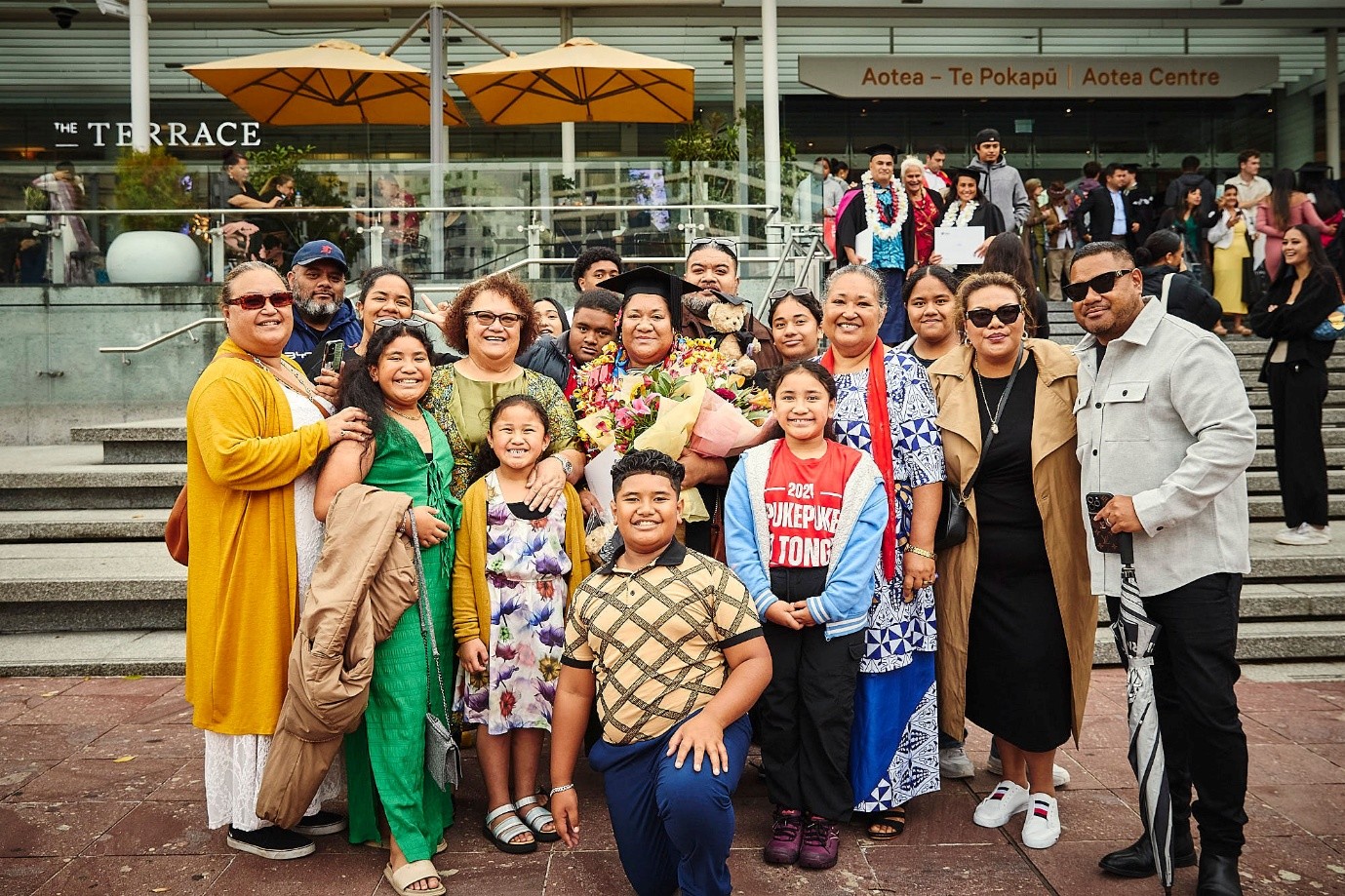
Sesilia with family members at her graduation in April 2025
My father is from Lapaha/Tatakamotonga and my mother is from ‘Atatā/Fotuha’a.
What makes me proud to be Tongan is our strong cultural values that we continue to practise in Tonga and throughout the wider diaspora.
Regardless of where we are in the world, we continue to be loud and proud of our ‘Tonganess.’
I keep my language and culture alive at home by speaking lea faka-Tonga, participating in cultural practices such as faiva fakatonga, joining in church prayers, listening to Tongan music and being surrounded by Tongan elders in my family.
Speaking Tongan allows me to express who I am, where I come from and the family, kainga and kin I am connected to. It gives me a way to share my Tongan heritage with the wider community.
I have also been able to bring my Tongan knowledge and cultural heritage into the academic space through my research. I draw on Tongan genealogy, oral histories, storytelling and lived experience, allowing my cultural knowledge to become part of my academic work.
Tongan Language Week is important to me because we get to celebrate and share our Tongan language, culture and heritage here in Aotearoa. It is dedicated not only to us as Tongans but also encourages the wider community to participate in the celebration.
I hope future generations continue to celebrate Tongan language during this dedicated week, but, more importantly, put it into practice in their everyday lives.
The aspect of Tongan culture that resonates with me most is “Nofo ‘a kāinga” – the living together of kin. It shapes how Tongan families and communities interact, live and preserve their culture. It is about living in harmony, sharing daily life, helping each other through life’s events, responsibilities and challenges, and preserving our cultural heritage and way of life.
“Preservation of language is preservation of culture”
 Dr Semisi James Prescott Senior Lecturer, Applied Business
I am from Manuka, in Hahake, in the northern part of Tongatapu. I am proud to be Tongan because it is who I am, but what makes me most proud is what Tongans have achieved collectively.
Language is at the heart of that identity. At home, I keep my language and culture alive by speaking lea faka-Tonga with my relatives, children and grandchildren. We are also part of a Tongan church, where our traditions and language are followed, practised and supported.
For me, the Tongan language is the vehicle that has carried both my identity and my culture. Without language, culture and tradition become vulnerable to being lost.
That connection to culture also extends into my mahi at MIT and Unitec. As an accounting lecturer, I draw on my project experience in Tonga and across the Pacific, using examples from Tonga and the wider Pacific to bring learning to life for my students.
Tongan Language Week is important because it reminds us that languages need to be remembered, nurtured and passed on. For me, preservation of language is preservation of culture.
I hope future generations understand the importance of holding on to lea faka-Tonga and the culture it carries. Language gives us a way to connect with where we come from and to carry our heritage forward.
One part of Tongan culture that resonates strongly with me is the four golden pillars that characterise Tongan society. These values are an important part of who we are and how we relate to one another.
And, of course, no celebration of Tongan culture would be complete without food. My favourite Tongan delicacies are lu pulu, ufi and kapapulu – dishes that, like our language, connect us to home, family and heritage.
“Family and respect is at the heart of everything”
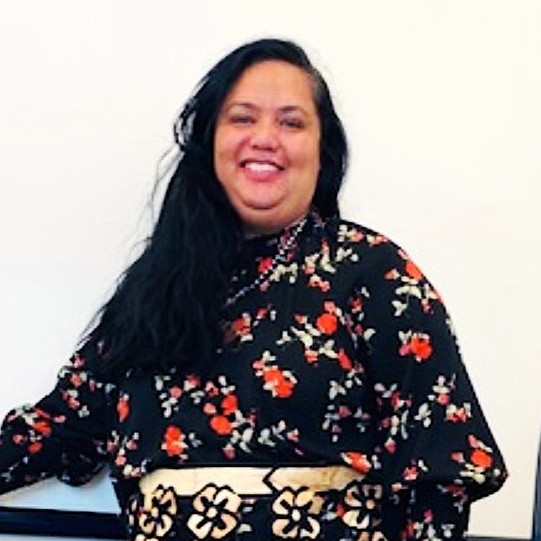
Christina Vailahi Tongan Student Association President
I am very proud to be of Tongan descent because of the strong sense of family, respect and community that is part of our culture.
I have a Māori mother and a Tongan father from Lifuka in Ha’apai and Lapaha, Mu’a and Tatakamotonga in Nuku’alofa.
Growing up in a Tongan Catholic family, I learned the importance of valuing family, respecting elders and remembering where I come from. I’m proud of Tongan history, language and traditions, and particularly the way Tongans support and care for one another.
While I’m not fluent in lea faka-Tonga, I make an effort to keep the language alive by using the Tongan I know with family and friends, particularly elders and relatives.
Keeping culture alive is about more than language alone. It is reflected in everyday life – through respect, sharing, helping one another and staying connected as a family. Tongan food, music, church and cultural celebrations are also important ways I maintains that connection.
Those everyday things help keep our culture present in my life rather than only celebrating it on special occasions.
Even speaking a little lea faka-Tonga gives me a strong sense of connection to my identity and heritage.
Our language carries our stories, values and history. When I speak Tongan, I feel like I am carrying a part of my ancestors and heritage with me. It reminds me that my identity is connected to generations before me.
Respect, humility, hard work and supporting others are values I live by and bring into my work and studies.
In Tongan culture, we learn the importance of working together and looking after our community, and I try to carry those values into my learning environment.
Being part of MIT and Unitec also gives me an opportunity to be proud of my identity and share aspects of Tongan culture with people from different backgrounds.
As President of the Tongan Association, Tongan Language Week has a special significance for me. I see it as an opportunity to celebrate and strengthen lea faka-Tonga, while reminding us that language is something valuable that needs to be protected and passed on.
I hope future generations will not only learn how to speak lea faka-Tonga, but also understand the meaning, history and values behind the language. I want them to feel proud of being Tongan and confident in carrying our culture forward.
Of all the aspects of Tongan culture, it is the importance of family and respect that resonates most strongly with me.
Family and respect is at the heart of everything. We are taught to respect our elders, support our relatives and contribute to our community. Those values have shaped the person I am today, and they continue to guide me in my everyday life.
And, of course, food is another important connection to culture. My favourite Tongan delicacy is ‘ota ‘ika, the traditional raw fish dish. I love it because it is fresh, full of flavour and reminds me of home and family gatherings. Food is such an important part of Tongan culture because it brings people together, and sharing a meal with family is something I really value.
 Learn some common Tongan Phrases
- Mālō e lelei: Hello / Greetings
- Fēfē hake?: How are you?
- Sai pe: I am fine / Good
- Mālō ‘aupito: Thank you very much
- Alu ā: Goodbye (to someone leaving)
- Nofo ā: Goodbye (to someone staying)
Quick Facts
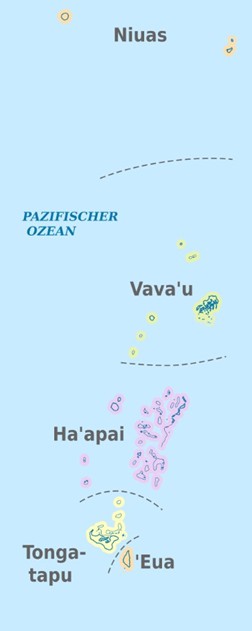
- The Kingdom of Tonga is located approximately 1,800km north of New Zealand.
- Tonga has 171 islands, of which 45 are inhabited.
- Tonga has a population of around 106,000, 70% of whom reside on the main island, Tongatapu.
- 97,824 people of Tongan ethnicity live in New Zealand (2023 NZ Census).
- About 33.5% of Tongans in New Zealand were born overseas.
- 7% of Tongans in New Zealand live in the Auckland region. Māngere-Ōtāhuhu local board area had the highest concentration of Tongan people at 20.1%.
- Tonga was first inhabited roughly 2,500 years ago by people who were a part of the Lapita culture, Polynesian settlers who gradually evolved a distinct and strong ethnic identity, language, and culture as the Tongan people.
- From 1900 to 1970, Tonga had British protected-state status, but Tonga never relinquished its sovereignty to any foreign power.
- In 2010, Tonga took a decisive step away from its traditional absolute monarchy and became a semi-constitutional monarchy.
Tonga is a member of the Commonwealth of Nations, the United Nations, the Pacific Islands Forum, and the Alliance of Small Island States.
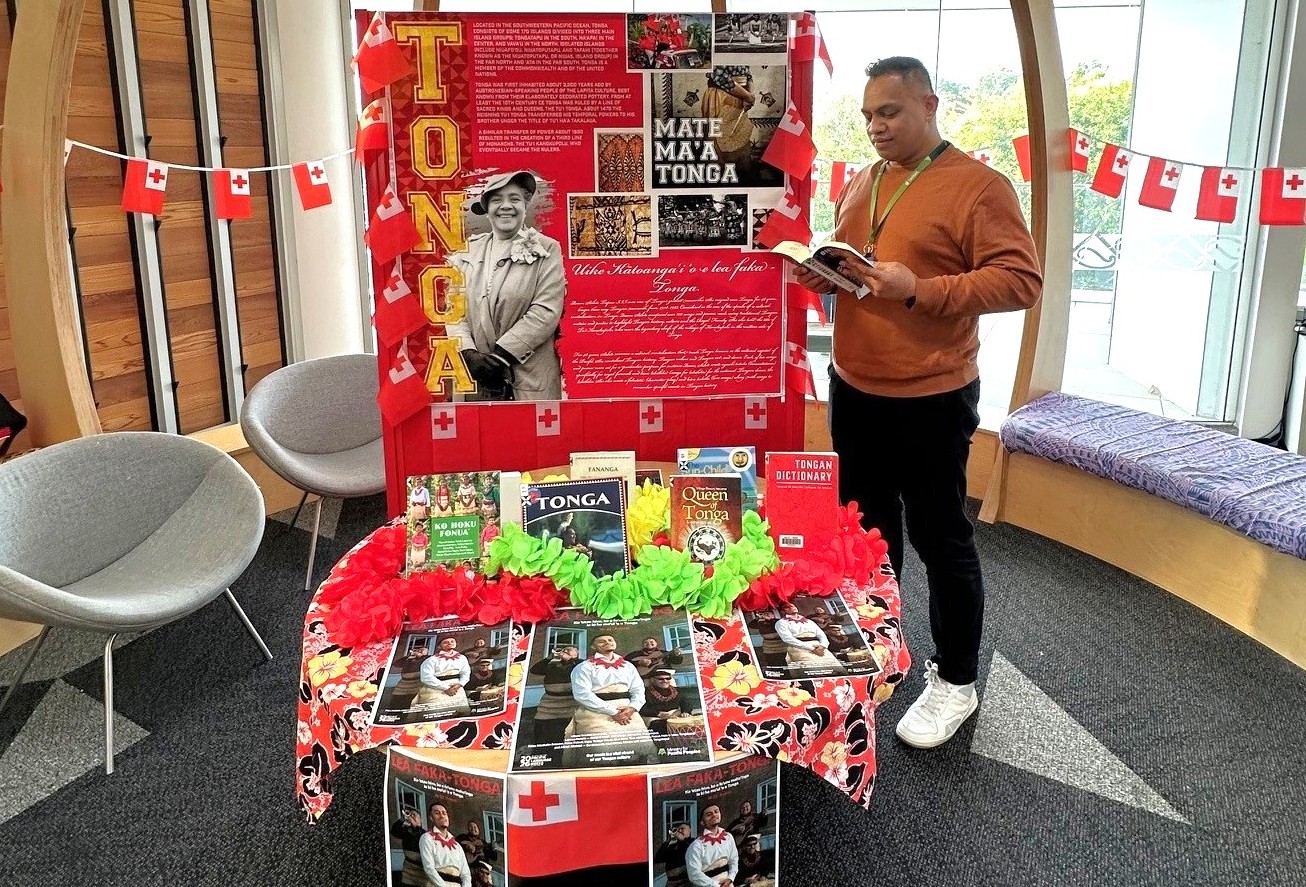
Visit our Tongan Language Week display at the Koru Pod in Te Puna, B180