


(L-R) Associate Professor Dr James Oldfield, Rochelle Irving and Sharnelle Aumua were in Wellington for the Tertiary ICT Excellence Awards where their Ako AI Agents project was placed third overall nationallyIn Brief:
- A team from across the organisation placed third overall at the Tertiary ICT Excellence Awards, earning a $2,500 prize for the Ako AI Agents project.
- Since the project’s launch in 2025, more than fifty AI agents are now supporting around 3,000 users through 8,000+ conversations across nursing, engineering, business, animal sciences, trades and student services.
- The project brought together expertise from across MIT and Unitec, helping establish a shared approach to AI innovation, governance and capability.
MIT and Unitec took third place overall at the Tertiary ICT Excellence Awards in Wellington for its innovative Ako AI Agents project.
The work earned praise for influencing wider institutional policy as well as teaching and learning practices across the organisation.
The recognition was received at the 42nd Annual Tertiary ICT Conference from 25–27 August.
The Ako AI Agents team received a $2,500 prize for their project, Taming Agents in the Wild West: Building a Platform from Responsible Development to Informed Governance – an initiative demonstrating how artificial intelligence can be embedded in tertiary education while maintaining strong governance, oversight and a focus on meaningful learning outcomes.
Powered by the Cogniti platform, Ako AI Agents integrates specialist AI chatbots directly into the Learning Management System, giving our ākonga ‘learners’ immediate access to course-specific tutoring, skills practice and feedback.
Since its launch in 2025, more than fifty AI agents have been developed, supporting approximately 3,000 users through more than 8,000 conversations across our delivery.
The agents are already being used across a diverse range of disciplines and services, including nursing, engineering, business, animal sciences, trades, student services, programme development and assessment design.
For Associate Professor Dr James Oldfield, who attended the awards with colleagues Sharnelle Aumua and Rochelle Irving from Te Puna Ako, the national recognition demonstrates how our educators are moving AI from experimentation into real-world educational impact.
“By combining educational innovation with robust governance and a strong focus on human-centred design, the project demonstrates how tertiary institutions can move beyond experimentation and establish AI as a sustainable, trusted, and scalable capability that delivers real value for learners, educators, and the wider community,” Assoc. Prof. Oldfield says.
Rather than simply introducing AI tools, the project has established a full-lifecycle framework for the responsible development, evaluation, maintenance and governance of AI agents.
This allows kaiako ‘teaching staff’ to work alongside agent developers to identify genuine teaching and learning challenges and create AI-supported solutions while maintaining institutional oversight and quality standards.
“A critical part of the development approach is that it actively involves kaiako and ākonga in the design process, helping build trust and ensuring agents are aligned with genuine teaching and learning needs.”
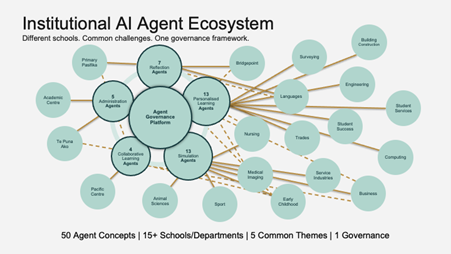
A map of the Institutional AI Agent Ecosystem across MIT and Unitec
The impact is already being felt in the classroom.
In nursing education, an AI-powered assessment conversation simulator creates a unique, auditable conversation for students to use as part of their assessment.
Other agents are supporting programme design, assessment development and moderation, working alongside academic advisors and drawing on existing institutional expertise and guidance.
The project’s governance model was a key factor in its success with the judging panel in the way it maintains visibility over every deployed agent, including its purpose, data sources, usage patterns, performance and lifecycle.
This provides a coordinated approach to AI adoption, reducing duplication, supporting continuous improvement and enabling successful solutions to be shared across schools and disciplines.
The collaborative work has also played an important role in bringing together expertise across MIT and Unitec following the formation of the single regional organisation on 1 January 2026.
It has helped establish a shared approach to AI innovation while informing wider institutional policy, governance practices and approval processes.
Academic Advisor Sharnelle Aumua says the award is recognition of a much wider collective effort with valuable contributions from Sacha Garrity, Maia Topp, Emma Treadaway, Kait O’Callahan, Sandra Pearce and Ollie Gardener. The team also acknowledged the support of project sponsors Deputy Chief Executive – Academic Professor Martin Carroll and Deputy Chief Executive – Learner Experience and Success Dr Simon Nash.
“Every collaboration has taught us something, challenged our thinking and helped shape what our agent ecosystem has become,” Sharnelle says.
“This award reflects the collective effort, thinking, testing, problem-solving and care that has gone into getting us to this point. Excited about where we go next.”
Find out more about the 42nd annual Tertiary ICT Conference https://www.tertiaryictconference.co.nz/